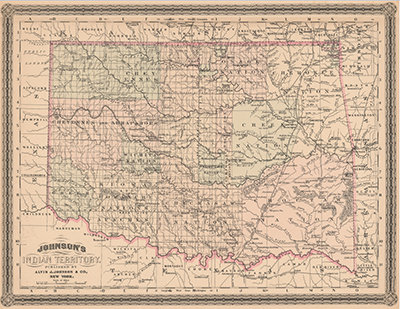
Family and community have always played a major role in the survival and prosperity of our Chickasaw people. This sense of belonging to a greater whole translated itself into a stronger national pride. The Chickasaw Nation established its Constitution of 1856 during huge gatherings at Good Spring (now Tishomingo, Oklahoma), and we established our own territory in present-day, south-central Oklahoma. Despite numerous challenges and occasional setbacks, our Chickasaw people continued to create new ways to protect and manage the new lands and water and to protect wildlife and natural resources.
Shortly after the forced removal from our Southeastern Homeland, homes were rebuilt, farms recreated, communities and businesses reestablished, churches and even commissioned schools re-erected. Infrastructure sprang up out of the land, connecting towns and creating new roads. Industry and commerce became a way of life. A governor was chosen, rather than a chief, to serve as the “supreme executive power.”
Throughout the days of Indian Territory, Chickasaws were blessed with strong leadership from elected senators, legislators and judges. From 1856 to 1906, several men were elected to serve as governor. The legislators drafted legislation, and governors presided over the day-to-day operations of tribal government. Governors led the Chickasaw Nation through the Civil War and its subsequent reconstruction. With the promised protection of the federal government abandoned, the tribe joined forces with the Confederacy during the “War Between the States.”
Following the Union’s victory in 1865, the Chickasaw and Choctaw tribes were forced by treaty to relinquish a huge portion of their lands known as the Leased District in what is now southwestern Oklahoma.