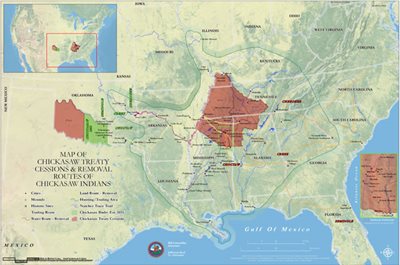
From migration to what is now Mississippi, Kentucky, Alabama and Tennessee in prehistoric times to the purchase of the new homeland in south-central Oklahoma in the mid 1800's, the Chickasaw culture and heritage have always had roots in nature and the elements.
Revered in ancient times as "Spartans of the Lower Mississippi Valley," the first contact with Europeans was with Hernando de Soto in 1540. Living in sophisticated town sites, the Chickasaws possessed a highly developed ruling system complete with laws and religion. They conducted a successful trade business with other tribes and with the French and English, and lived largely an agrarian lifestyle, but were quick to go to battle if necessary. They allied with the English during the French and Indian War. Some historians give the Chickasaws credit for the United States being an English-speaking country.
The Chickasaw people moved to Indian Territory during the "Great Removal," on what was called the "Trail of Tears." Other tribes forced to relocate were the Cherokee, Choctaw, Creek and Seminole, called the "Five Civilized Tribes" because of their highly developed ruling systems. The Chickasaws were one of the last to move. In 1837, the Treaty of Doaksville called for the resettlement of the Chickasaws among the Choctaw tribe in Indian Territory. In 1856, the Chickasaws, in order to restore direct authority over their governmental affairs, separated from the Choctaws and formed their own government.
Tribal leaders established the capital at Tishomingo, adopted a constitution and organized executive, legislative and judicial departments of government with the offices filled by popular election. At the outbreak of the Civil War, the Chickasaws signed an alliance with the South and raised troops to fight with the Confederacy. The respected Choctaw/Chickasaw Mounted Regiment, headquartered at Fort Washita, fought some of the last battles of the Civil War. Although suffering hardships after the defeat of the Confederacy, the tribe regained prosperity. Many Chickasaws became successful farmers and ranchers. Chickasaws built some of the first schools, banks, and businesses in Indian Territory.
After Oklahoma statehood in 1907, the President of the United States appointed the principal officers of the Chickasaw Nation. In 1970, Congress enacted legislation allowing the Five Civilized Tribes to elect their principal officers. In 1983, a new Chickasaw constitution was adopted.